
Discover the Elephant Reserves in India, where majestic Asian elephants roam through forests, grasslands, and wildlife corridors protected for their conservation and survival.
Table of Contents
Introduction
India is home to one of the largest wild elephant populations on Earth. These magnificent animals — revered, feared, and deeply woven into the country’s cultural fabric — have long shared space with human settlements, forests, and farmlands. But in recent decades, growing pressure on forests and rising human-elephant conflict made it clear that elephants needed dedicated, legally protected spaces. That is where Elephant Reserves come in.

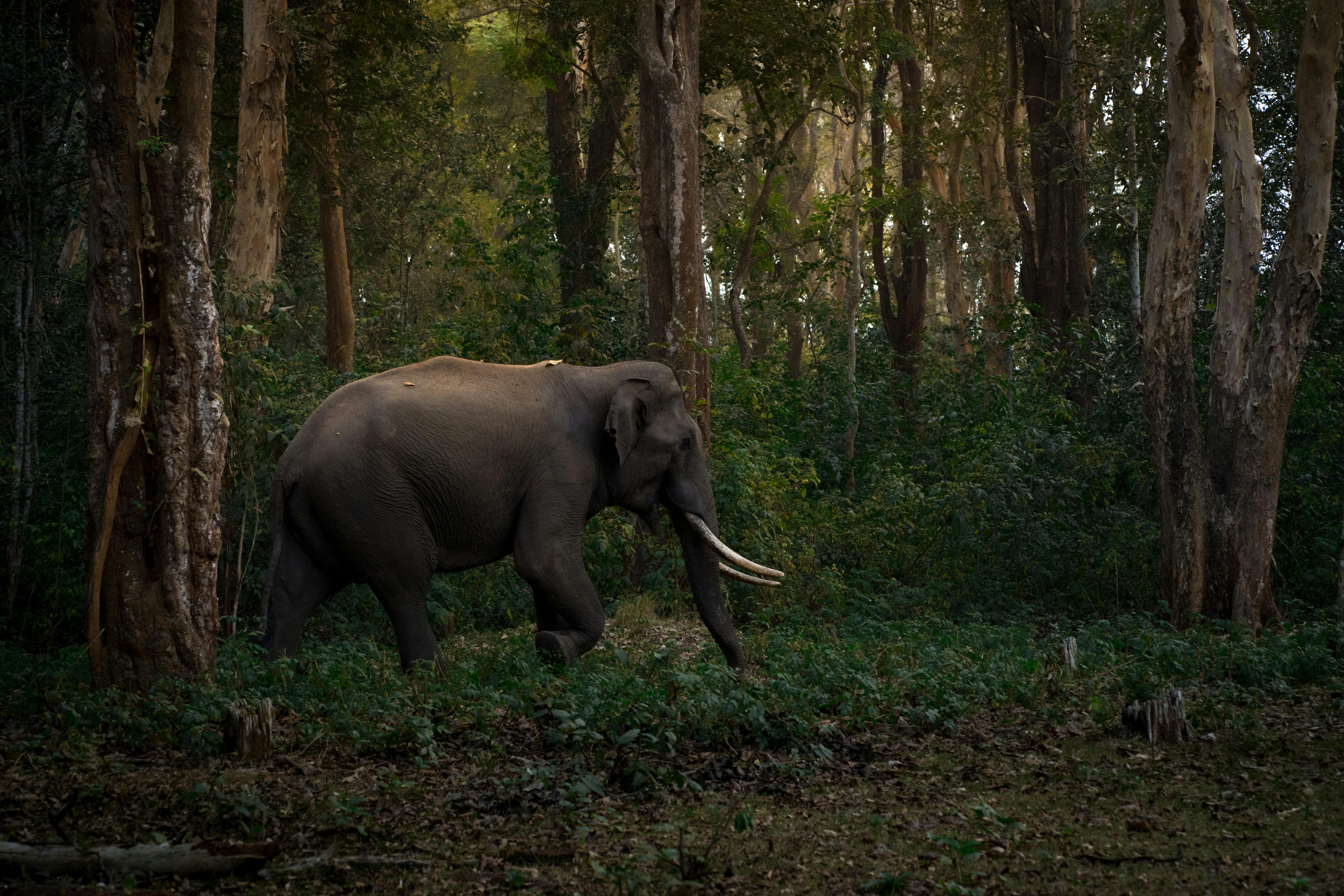
An Asian elephant in lush greenery of Madikeri, India. Image credit : Tanmay Paul
What Is an Elephant Reserve?
An Elephant Reserve is a designated area set aside by the Government of India specifically to protect elephants, their habitats, and their migratory corridors. Unlike National Parks or Wildlife Sanctuaries — which protect all wildlife within a fixed boundary — Elephant Reserves are designed with the elephant’s unique need for large landscapes in mind.
Elephants are not creatures that stay in one place. They travel vast distances in search of food, water, and mates. A reserve that is too small or disconnected from other forests is, for an elephant, essentially a prison. Elephant Reserves are created to ensure that these corridors of movement remain intact and legally protected.
These reserves often overlap with Tiger Reserves, Wildlife Sanctuaries, Reserved Forests, and National Parks — all protected under the Wildlife (Protection) Act of 1972, the Indian Forest Act of 1927, and various state-level forest laws. The Elephant Reserve is not a replacement for these designations but an additional layer of conservation focus.
The Birth of Project Elephant
The story of Elephant Reserves in India begins with Project Elephant, launched in February 1992 by the Ministry of Environment, Forest and Climate Change. It was a Centrally Sponsored Scheme — meaning the central government provides financial and technical support to individual states that have wild elephant populations.
When Project Elephant began, the wild elephant population in India had already suffered significant losses due to deforestation, agricultural expansion, and fragmentation of forest corridors. The project was designed to reverse this trend by:
— Protecting critical elephant habitats and migration corridors
— Resolving human-elephant conflict
— Providing veterinary care and welfare to captive elephants
— Supporting scientific research on elephant ecology
— Creating awareness in local communities living alongside elephants
In 2010, India formally declared the elephant its National Heritage Animal — putting it in the same class of national significance as the tiger.
How Many Elephant Reserves Does India Have?
As of 2026, India has 33 officially notified Elephant Reserves spread across 14 states, covering approximately 80,778 square kilometres of land. The first of these was the Singhbhum Elephant Reserve in Jharkhand, and the most recent additions include the Terai Elephant Reserve in Uttar Pradesh and the Agasthyamalai Elephant Reserve in Tamil Nadu, both notified in 2022.
The states that host these reserves are spread across four major elephant-bearing landscapes:
South India — The Western Ghats, including parts of Tamil Nadu, Kerala, and Karnataka, hold some of the richest elephant habitats in the world. The Nilgiri Elephant Reserve is the largest in India, spanning these three states.
Northeast India — Assam, Arunachal Pradesh, Meghalaya, and neighbouring states form a critical landscape for elephants in the Brahmaputra valley and beyond.
Eastern India — Odisha, Jharkhand, and West Bengal have historically hosted significant elephant populations, particularly in the forested hills of Singhbhum and the Eastern Dooars.
Northern India — Uttarakhand and Uttar Pradesh are home to elephant populations along the terai belt, the forested foothills of the Himalayas.
Notable Elephant Reserves in India

Nilgiri Elephant Reserve — Tamil Nadu, Kerala, Karnataka
This is the largest elephant reserve in India and arguably the most important. Covering a landscape that stretches across three states, it forms the core of the Nilgiri Biosphere Reserve. It is home to the densest wild elephant population in Asia. The interconnected forests here allow elephants to move freely across state boundaries.
Anamudi Elephant Reserve — Kerala
Nestled in the high ranges of the Western Ghats, this reserve surrounds the Anamudi peak — the highest point in South India. The thick shola forests and grasslands here are ideal elephant habitat. It connects with the Nilgiri landscape to the north and the Agasthyamalai landscape to the south.
Mysore Elephant Reserve — Karnataka
One of the historically significant reserves, the Mysore reserve connects forests in Karnataka with those in Tamil Nadu and Kerala. It includes famous landscapes like Nagarahole and Bandipur, long recognised as among the finest wildlife areas in India.
Singhbhum Elephant Reserve — Jharkhand
The first elephant reserve to be formally designated in India holds a special place in the country’s conservation history. The Singhbhum hills in Jharkhand are ancient geological formations covered in sal forests — traditional elephant country in eastern India.
Kaziranga-Karbi Anglong Elephant Reserve — Assam
This reserve combines the floodplain grasslands of Kaziranga — famous for one-horned rhinos — with the forested hills of Karbi Anglong. For elephants, this landscape provides both grassland grazing and forest shelter, making it an ecologically complete habitat.
Kameng Elephant Reserve — Arunachal Pradesh
Located in the foothills of Arunachal Pradesh, the Kameng reserve encompasses some of the most biodiverse forests in India. It includes the Pakke Wildlife Sanctuary and Eagle Nest Wildlife Sanctuary, and connects with Assam’s Sonitpur Elephant Reserve.
Terai Elephant Reserve — Uttar Pradesh
India’s 33rd and newest elephant reserve, notified in 2022, spans 3,049 square kilometres in the Dudhwa-Pilibhit belt along the Nepal border. This reserve protects a critical elephant corridor in the terai — the fertile, forested strip along the southern foothills of the Himalayas.
What Threats Do Elephants Face?
Elephant Reserves have helped stabilise populations, but the threats have not disappeared. India’s 2025 DNA-based Synchronous All-India Elephant Estimation (SAIEE) — the country’s first census using genetic methods — estimated the wild elephant population at around 22,446. This is lower than the 2017 count of approximately 29,964, but experts note that DNA-based methods provide a more scientifically accurate baseline than traditional counting techniques.
The biggest threats to elephants in India today include:
Habitat loss and fragmentation — Forests are cleared for agriculture, infrastructure, and industry. When forest patches are disconnected, elephants cannot move between them, which disrupts breeding and foraging behaviour.
Human-elephant conflict — As elephant habitats shrink, elephants increasingly enter farmland in search of food. Crop raids destroy livelihoods. Retaliatory killings, electrocution from illegal fences, and accidents on roads and railways kill dozens of elephants every year.
Mining — Coal and iron ore mining in central India — particularly in Odisha, Jharkhand, and Chhattisgarh — directly destroys elephant corridors. These mineral-rich states are also home to the highest density of elephant corridors in the country.
Poaching — Though India does not have the ivory crisis that has devastated African elephant populations, poaching for ivory, tusks, and other body parts remains a threat. Male elephants with large tusks are particularly vulnerable.
Conservation Efforts Beyond Reserves
The Indian government and conservation organisations have developed several innovative approaches to complement the Elephant Reserves:
The MIKE Programme — Monitoring of Illegal Killing of Elephants — was launched in South Asia in 2003 under CITES (the Convention on International Trade in Endangered Species). It tracks poaching levels across elephant range countries and informs conservation decisions.
The RE-HAB Project — Reducing Elephant-Human Attacks using Bees — is a creative initiative tested in Karnataka near Nagarahole National Park. By installing beehive fences along forest edges and village peripheries, the project uses the natural aversion elephants have to bees to deter them from entering human settlements. It is a sub-mission under KVIC’s National Honey Mission.
The Hathi Mere Sathi campaign, launched in 2011 in collaboration with the Wildlife Trust of India, worked to build public awareness and encourage peaceful coexistence between people and elephants.
The Elephant Task Force was established to comprehensively address the challenges of elephant conservation, particularly around corridors, conflict mitigation, and captive elephant welfare.
Elephant Corridors — The Connective Tissue
If Elephant Reserves are the strongholds of elephant conservation, corridors are the roads that connect them. The Ministry of Environment, Forest and Climate Change, together with state forest departments, has ground-validated 150 elephant corridors across 15 elephant-range states. These corridors pass through a mix of protected forests, revenue land, and private farmland.
Protecting these corridors is among the most complex conservation challenges in India. A corridor may pass through a village, cross a highway, or skirt the edge of a mine. In such cases, conservation demands dialogue with communities, developers, and state governments — not just on-the-ground protection.
Ecologically Sensitive Area declarations, conservation reserves, and voluntary relocation of villages from critical corridors are among the tools used to protect these wildlife pathways.
India’s Responsibility to the World’s Elephants
India harbours nearly 55% of the world’s wild Asian elephant population. That is not a statistic to take lightly. The fate of the Asian elephant, as a species, is significantly tied to what happens in India’s forests.
Karnataka hosts the largest number of wild elephants among Indian states — over 6,000 — followed by Assam with more than 4,000 and Tamil Nadu with over 3,000. These concentrations represent both India’s greatest conservation success stories and its greatest responsibilities.
Project Elephant, now in its fourth decade, has helped maintain a population that could otherwise have collapsed. But stability is not the same as security. The 33 Elephant Reserves across 14 states are a foundation — but they must be backed by living corridors, conflict resolution, and communities that see a future worth protecting in these forests.
India’s elephants are not just wildlife. They are living monuments to a landscape that has somehow survived millennia of human civilisation. Protecting them is not only a matter of ecology — it is a measure of what kind of country India chooses to be.



Leave a Reply