
India reveres the elephant as a divine symbol, yet thousands of captive elephants live in conditions of quiet suffering. This is a frank look at what ails the private captive elephant system — and a constructive argument for reforms that protect both animal welfare and human livelihoods
Table of Contents
Introduction
There is a peculiar contradiction at the heart of how India treats its elephants.
Ganesha, the elephant-headed god, sits in roughly every home, office, shop, and automobile in the country — a deity of beginnings, of wisdom, of the removal of obstacles. On festival days, a living elephant draped in silk and gold is led through streets thick with incense and devotion, worshipped as a manifestation of the divine. Schoolchildren learn that the elephant is India’s National Heritage Animal. Conservation programmes carry photographs of elephant herds in forests as emblems of a living, breathing India.

Image Credit : Anoop Vs
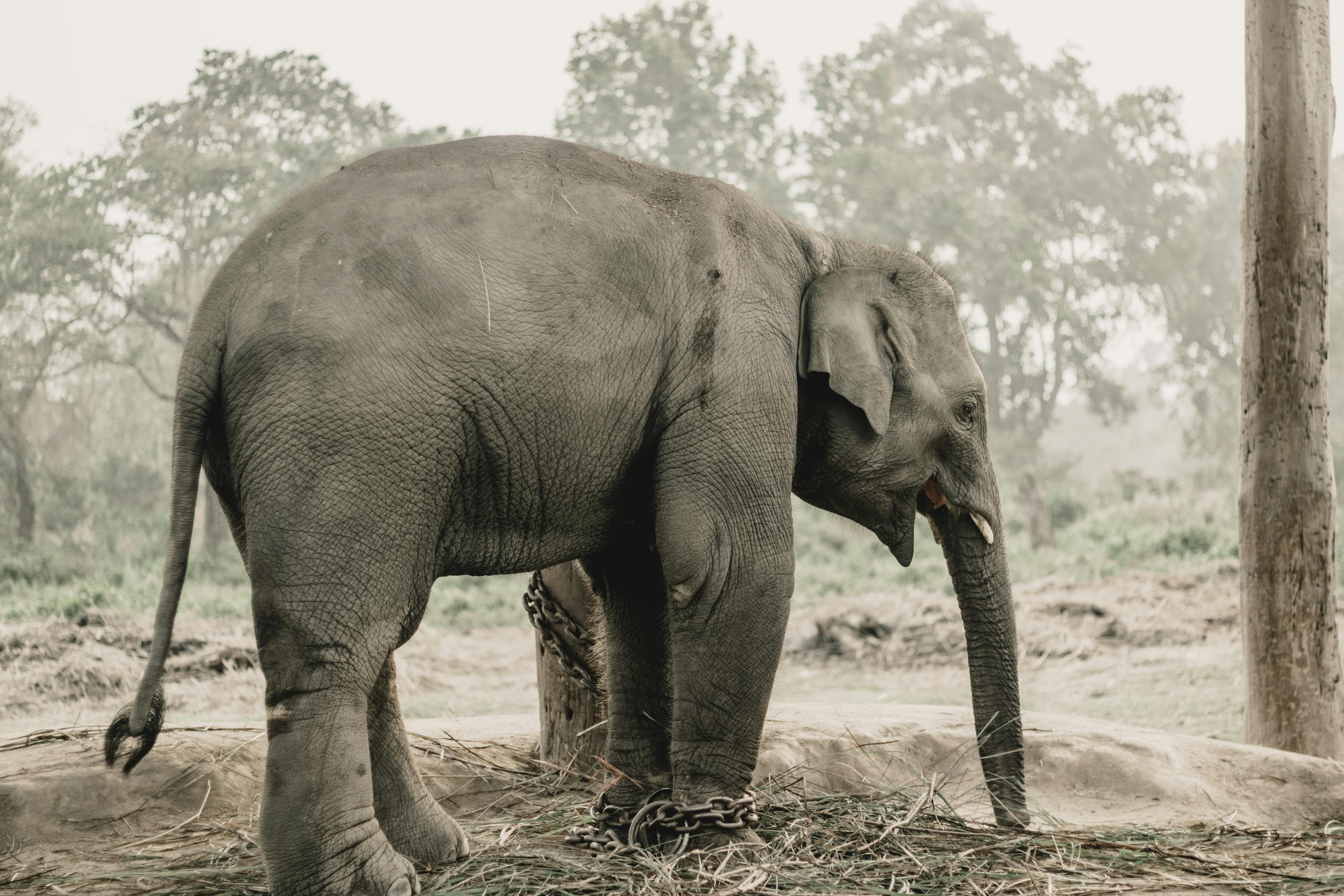
And yet, somewhere in Kerala today, an elephant stands chained on concrete for eighteen hours in a shed with no ventilation. Its feet — evolved over millions of years to pad across forest earth — are cracking on marble flooring. Its world, which in the wild would span hundreds of kilometres, has been reduced to a radius of a few metres. It has not seen another elephant in years. Tonight it will be loaded onto a truck and driven to a festival, where it will stand in a crowd of thousands, bombarded by firecrackers and amplified drums, under floodlights, for six hours — controlled by an ankush pressed against a festering wound behind its ear.
This is not a rare or isolated situation. It is the ordinary life of a significant portion of India’s approximately 2,500 privately held captive elephants.
This essay is not an attack on tradition. It is not a call for the overnight abolition of every institution that has involved captive elephants for centuries. What it is, is an honest reckoning — with facts, with failures, and with the possibility of something better. Because a country that genuinely reveres the elephant cannot continue to look away from what is happening in its name.
What the Numbers Say
India’s captive elephant population has been declining for decades. Where once thousands of elephants worked in forests, temples, and royal courts, the count has fallen substantially. Today, approximately 2,500 captive elephants remain across India, with the highest concentrations in Kerala (around 400–500), followed by Tamil Nadu, Karnataka, Assam, and Rajasthan.
Around 70 per cent of captive elephants in Kerala are over 50 years old. The average life expectancy of an elephant is 80 to 85 years — which means these animals have potentially decades of life ahead. But they have also spent decades being worked, chained, paraded, and transported. The physical and psychological accumulation of that history is significant.

Image Credit: Miguel Cuenca
The economics are blunt. A desirable elephant fetches roughly ₹50,000 per day for a temple parade in Kerala. Celebrity tuskers command ₹3,00,000 or more per appearance. During festival season — Thrissur Pooram, Onam, the temple festival circuit — demand is intense and scheduling is relentless. Elephants are signed on to contracts by owners, leased out to organisers, transported across districts and sometimes states, and presented at event after event. The animal’s welfare is, in this system, a secondary consideration to its commercial utility.
This is not the fault of any one person. It is the output of a system — cultural, economic, legal — that has evolved without adequate welfare infrastructure.
The Physical Reality: What Captivity Does to an Elephant
An Asian elephant in the wild walks 25 to 50 kilometres per day, foraging for 18 to 20 hours across diverse terrain. It lives in a complex social unit — a matriarchal herd of related females and young, with bulls ranging independently. It is a profoundly intelligent, emotionally sophisticated animal with a long memory, deep social bonds, and documented capacity for grief, play, empathy, and problem-solving.
Private captivity in India inverts almost every aspect of this natural existence.
Social isolation is the norm for most privately held captive elephants. Many are housed alone, sometimes for their entire working lives. For an animal whose cognitive and emotional life is built around social relationships, this is not merely uncomfortable — it is a form of chronic psychological deprivation. Researchers have compared prolonged solitary confinement in elephants to the same in humans: the outcomes are anxiety, stereotypic behaviour (repetitive swaying or head-bobbing), and what would clinically be described as a depressive state.
Flooring and foot damage is among the most widespread and preventable forms of suffering in captive elephants. Elephants evolved to walk on soft, yielding earth. Their massive weight — several tonnes — is distributed through specialised feet designed for natural substrates. Concrete, granite, marble, and tarmac roads cause chronic pain, cracking, abscessing, and arthritis. A CUPA (Compassion Unlimited Plus Action) survey of Kerala temple elephants found that chaining duration in many cases was 18 to 22 hours per day — leaving animals standing on hard surfaces for the vast majority of their lives.
Training and control methods in private captivity frequently rely on pain and fear. The ankush (bullhook) — a sharp metal implement — is used to direct and correct elephants. In documented cases, wounds are deliberately opened and kept raw so that subsequent pressure on the area produces compliance through pain. Bulls in musth — a natural testosterone-driven state that elephants enter annually — are especially vulnerable to abuse during this period, as mahouts attempt to suppress the animal’s natural heightened state through beatings, starvation, and prolonged chaining.
Transport stress is a compounding factor for privately held elephants that work the festival circuit. Being loaded into trucks, driven through the night, unloaded at a festival ground, subjected to crowd noise and fireworks for hours, then driven again — this cycle, repeated dozens of times through a festival season, creates a cumulative physiological and psychological load that contributes directly to the aggression that periodically results in tragedy.
The Human Cost: Mahouts and Owners
It would be dishonest — and it would also be bad policy — to frame this issue as simply elephants versus owners. The human dimension of India’s captive elephant system is complex and deserves serious attention.
The mahout is among the oldest professional identities in South and Southeast Asia. For many communities — particularly tribal communities in Assam, Arunachal Pradesh, Karnataka, and elsewhere — mahout practice is not just a job but an inherited knowledge system, a cultural identity, and a livelihood passed down through generations. The deep bonds that form between individual mahouts and their elephants over years and decades are real, documented, and profound. Many mahouts are genuinely devoted to the animals in their care.
But the mahout profession has been under strain for decades. The social status of mahouts has declined as their communities have urbanised. Salaries in the private sector are dramatically lower than in forest department camps — research in Tamil Nadu found that forest department mahouts earned roughly twice the salary of private mahouts, and nearly three times that of temple mahouts. The profession attracts fewer young people, resulting in high turnover in private captivity. When mahout-elephant bonds are broken by the departure of a familiar handler and replaced by a stranger, the elephant’s stress increases — and so does the risk of violence.
Elephant owners, too, occupy a complicated position. Many entered elephant ownership through inheritance or cultural tradition, not commercial calculation. The escalating costs of veterinary care, fodder, and compliance with legal requirements fall on owners who may lack the resources to meet them. The 2024 Captive Elephant (Transfer or Transport) Rules, which require veterinary certification, genetic profiling, and habitat assessment before transfers, add administrative burdens that small-scale or rural owners find difficult to navigate.
The result is a system in which:
- Owners lack incentives to invest in welfare because the regulatory floor is low
- Mahouts are underpaid and undervalued, contributing to high turnover and erratic animal care
- Elephants bear the cumulative cost of both these failures
The system, as currently structured, fails all three parties — and most acutely, the animal.
What the Law Says — and Where It Falls Short
India’s legal framework for captive elephants is more substantial than most people realise. The Wildlife Protection Act, 1972 places elephants on Schedule I — the highest protection category. Captive elephants cannot be traded without permission from the Chief Wildlife Warden. They cannot be used during musth. They must have sufficient food, water, and veterinary care. Rules against chaining for excessive durations, against spiked hobbles, and against involvement in dangerous situations have existed for years.
The Captive Elephant (Transfer or Transport) Rules, 2024 introduced by the Ministry of Environment, Forest and Climate Change updated the transfer framework, requiring veterinary health certificates, genetic profiling, and habitat suitability assessments for transfers. A national genetic database for captive elephants was mandated — a significant step toward closing the documentation gaps that allow illegal transfers and ownership fraud.
And yet, enforcement remains the critical weakness. The Heritage Animal Task Force in Kerala documented that captive elephants killed 526 people over a 15-year period — a statistic that reflects not the dangerousness of elephants but the consequences of managing stressed, pain-ridden animals in inappropriate conditions and expecting them to perform. Activists and wildlife authorities regularly document violations of existing rules. Musth animals appear at festivals. Chaining durations far exceed legal limits. Wounds are covered with ash and cloth to conceal them from inspectors.
The gap between law on paper and practice on the ground is wide. It is not primarily a gap in legislation — it is a gap in monitoring, accountability, and political will.
The Search for Alternatives: What Is Already Working
The conversation around captive elephants in India has been dominated, unhelpfully, by a false binary: either you support tradition (and therefore accept the current system) or you support animal rights (and therefore want all captive elephants released immediately). Neither position is workable or honest.
The more productive question is: what does a better system look like? And here, there are already instructive examples.
Mechanical elephants have emerged as a practical, aesthetically credible alternative for temple festivals, particularly in Kerala. Life-sized robotic elephants — constructed from rubber, fibre, metal, and foam — are now being used in several temples, including the Irinjadappilly Sree Krishna Temple in Thrissur, which introduced its robotic elephant Irinjadappilly Raman to wide public acceptance. Mechanical elephants can sway, lift their trunks, and flap their ears. They require no food, no mahout, no veterinary care, and pose no safety risk. They are increasingly being ordered by festivals and even exported internationally. The Better India estimated in April 2026 that demand for mechanical elephants is growing, with orders coming not just from South India but from international performance groups.
This is not a perfect solution — but it is a viable, scalable one for the specific context of festival parades. The objection that a mechanical elephant cannot carry the spiritual weight of a living one is worth taking seriously. But the counter-question is equally serious: can an animal in visible distress, controlled by an ankush, mediate divine presence? Many temple authorities themselves are asking that question.
Elephant sanctuaries and welfare camps represent another model. The Wildlife Rescue and Rehabilitation Centre (WRRC) in Bangalore provides a template: confiscated or surrendered elephants are given access to forest habitat in Bannerghatta National Park, spending 16 hours daily foraging, socialising with other elephants, and living in conditions as close to natural as captivity allows. The elephant Menaka, rescued from abusive temple captivity, took three years to adapt but is now documented in stable health with social bonds to other animals in the facility.
Government forest camp models in Karnataka, Assam, and Kerala — where elephants used for forest management and anti-poaching work are maintained in well-monitored camps — show that captive elephant welfare and utility need not be mutually exclusive. Forest department mahouts are better paid, better trained, and more stable in their employment than their private counterparts. The elephants in these camps, while still captive, have better dietary conditions, more social contact, and greater physical space.
A Constructive Middle Path: What Reform Could Look Like
The following is not a utopian wish list. It is a set of pragmatic, implementable reforms that would make the existing system significantly better for elephants and safer for humans — while preserving the livelihoods of mahout communities and giving traditions the space to evolve rather than collapse.
1. Mandatory Welfare Standards with Real Enforcement
Existing laws prohibiting excessive chaining, inadequate food and water, and use of musth animals must be enforced. This requires dedicated, trained wildlife inspectors with regular access to captive elephant facilities — not just paper compliance. The genetic database mandated by the 2024 rules must be fully operationalised. Microchipping, already required, must be cross-referenced against visible welfare conditions at every inspection.
2. A Mahout Dignity and Training Programme
The single most effective welfare intervention for captive elephants would be improving the conditions, salaries, and training of mahouts. A nationally standardised mahout certification programme — covering positive reinforcement training, elephant behaviour, first-aid, and legal requirements — would raise the floor of care quality across the private sector. Better-paid, better-trained mahouts stay longer. Continuity of the mahout-elephant relationship is itself a welfare intervention.
3. A Captive Elephant Welfare Fund
Owners of captive elephants cannot be expected to bear the full cost of welfare improvements alone, particularly when many are not generating significant profit from their animals. A centrally funded Captive Elephant Welfare Fund — contributed to by state governments, elephant parade organisers, and tourism revenue from elephant-related activities — could subsidise veterinary care, fodder costs, and enclosure improvements for owners who agree to meet audited welfare standards.
4. Festival Rotation and Rest Mandates
An elephant should not be required to attend more than a defined number of events per month, or to be transported more than a defined number of kilometres per year. Mandatory rest periods between events, particularly for animals over 40 years old, would reduce cumulative stress without ending the tradition of elephant participation in festivals. This is not fundamentally different from labour regulations for human workers — and it would substantially reduce the frequency of elephant stress-events that lead to human deaths.
5. Phased Sanctuary Access for Old and Infirm Elephants
Elephants over 60 years old, or animals with documented health conditions, should be systematically moved to accredited sanctuaries rather than continuing on the festival circuit. This requires building sanctuary capacity — a genuine gap in India’s current infrastructure — but it also requires a cultural shift: accepting that a retired temple elephant is not a failure but a dignified conclusion to a long relationship.
6. Community-Owned Elephant Conservation Centres
Several tribal communities in Northeast India and Karnataka have multi-generational mahout traditions and deep knowledge of elephant care. Supporting these communities to establish community-owned elephant centres — where elephants live in natural social groups, mahouts are employed at dignified wages, and responsible eco-tourism provides revenue — would preserve an irreplaceable cultural knowledge system while creating conditions far superior to current private captivity.
The Larger Picture
India’s captive elephant problem is not separate from India’s wild elephant crisis — they are expressions of the same underlying tension. A country that cannot protect the dignity of the elephants it owns and worships will struggle to build the broader culture of human-wildlife coexistence that wild elephant conservation demands.
The captive elephant system, at its worst, teaches a generation of Indians that an elephant is a commodity — an object that produces festival spectacle and economic returns, whose distress is managed through pain, and whose natural needs are irrelevant to its cultural function. That lesson bleeds outward. It shapes how communities respond to wild elephants raiding crops at the forest edge. It shapes how quickly politicians protect elephant corridors. It shapes the ambient cultural attitude toward a species that India has the most to lose if it disappears.
Conversely, a captive elephant system that treats these animals with the dignity their intelligence and sentience demand would teach something different. It would say that India’s relationship with the elephant is not one of ownership and exploitation dressed up in religious language — but one of genuine coexistence, grounded in respect and reciprocity.
The elephant god Ganesha is, in most traditions, depicted as happy. Not chained. Not stressed. Not paraded through crowds on cracked, bleeding feet.
The least we can do is try to match the iconography.
A Summary of Recommendations
| Reform | Benefit for Elephants | Benefit for Livelihoods |
|---|---|---|
| Mandatory welfare audits with enforcement | Reduced suffering, earlier intervention | Clearer standards, less legal ambiguity |
| National mahout certification + better pay | More consistent, humane care | Dignified profession, reduced turnover |
| Captive Elephant Welfare Fund | Subsidised vet care, better enclosures | Financial relief for small owners |
| Festival rotation limits | Reduced transport and crowd stress | Legal protection for organisers |
| Sanctuary access for elderly elephants | Dignified later years | Reduces owner liability for infirm animals |
| Community elephant conservation centres | Social living conditions, forest access | Sustainable eco-tourism income for tribal mahouts |
READ MORE
What are elephant reserve in india.



Leave a Reply