
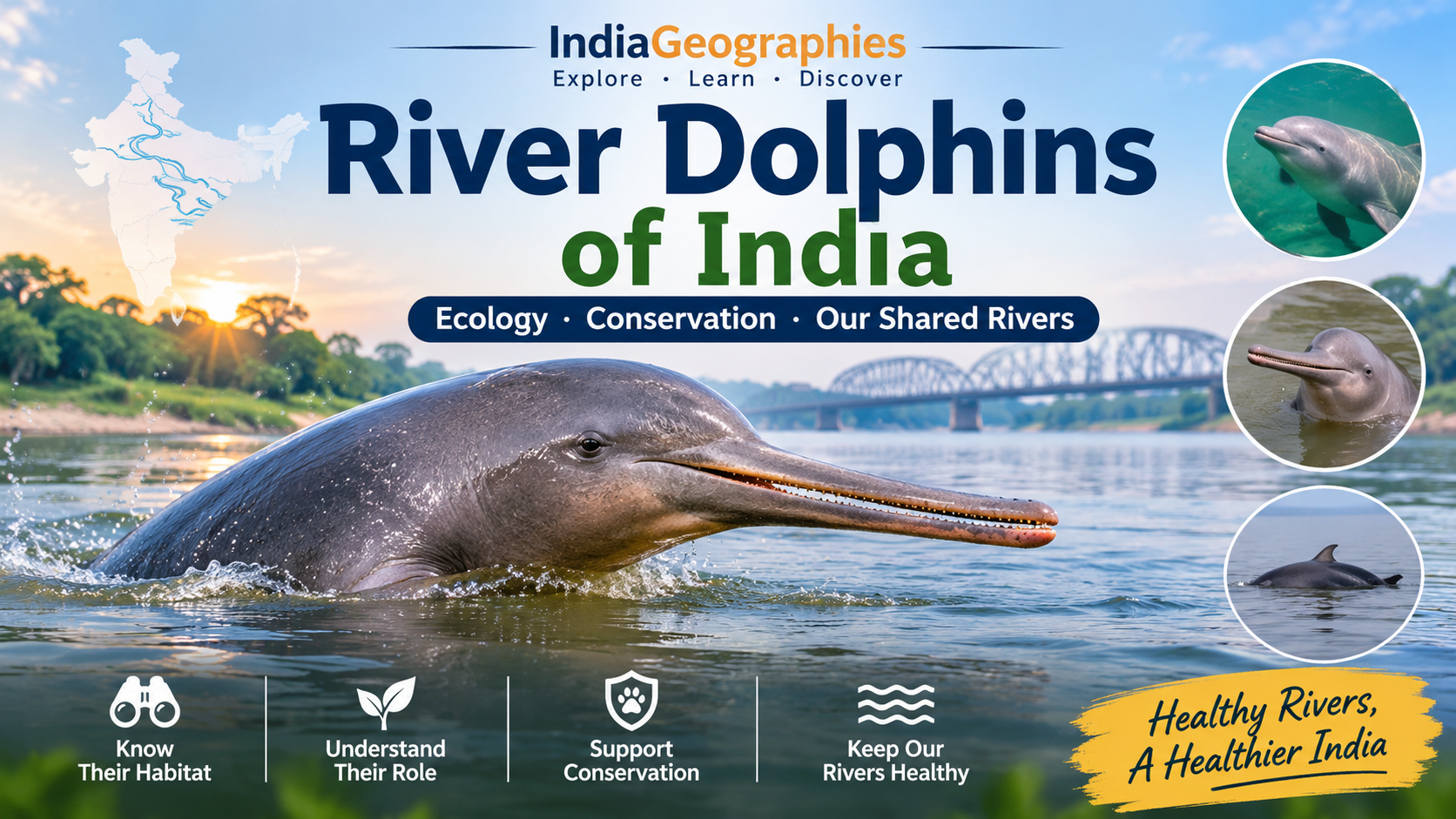
India’s rivers support an extraordinary range of aquatic life, and river dolphins are among their most distinctive inhabitants. Their presence connects the story of freshwater biodiversity with the condition of river channels, fish communities, water quality and the livelihoods of people who depend on these waters. This guide introduces the river dolphins recorded in India, explains where they occur, how scientists monitor them, and why conserving dolphins requires looking after entire river systems.
Table of Contents
Which river dolphins are found in India?
The Wildlife Institute of India’s 2021–22 field guide, Monitoring Ganges and Indus River Dolphins, Associated Aquatic Fauna and Habitat, identifies two river dolphin species inhabiting India: the Ganges river dolphin (Platanista gangetica) and the Indus river dolphin (Platanista minor). Their Indian distributions are very different. Ganges river dolphins occur across parts of the Ganga–Brahmaputra river systems and connected tributaries, while the Indian population of the Indus river dolphin is restricted to a small stretch of the Beas River in Punjab.
Ganges river dolphin: a freshwater specialist
Where are Ganges river dolphins found?
Indus river dolphin in India
The Indus river dolphin is a separate species from the Ganges river dolphin. In India, the field guide places the small known population in the Beas River in Punjab, around the Beas–Harike area. It contrasts this restricted Indian occurrence with the much larger population historically reported from Pakistan. Because the Indian population is small and geographically limited, careful monitoring of its distribution, habitat and survival is particularly important.
Why river dolphins matter to the health of rivers
Major threats facing India’s river dolphins
How scientists monitor river dolphins
The WII guide sets out a monitoring framework that combines dolphin population surveys with habitat assessment and monitoring of associated biodiversity. It describes three visual survey approaches selected according to river size and navigability: double-observer surveys, boat-in-tandem surveys and single-boat surveys.
Double-observer surveys
On suitable larger rivers, two independent observer teams work from separate platforms on the same boat, divided by a visual barrier. Their records can be compared using a capture–recapture framework to estimate and correct for animals missed by one team. Synchronised time and GPS records, consistent boat speed, trained observers and accurate notes about sighting angle and distance are essential.
Boat-in-tandem surveys
Where the river can be surveyed by two smaller boats, teams travel in tandem and record sightings independently. Matching observations later helps researchers identify duplicate sightings and account for detection differences. The approach is useful in some wide rivers and tributaries where a large double-deck vessel is unsuitable.
Single-boat surveys
In narrow or shallow tributaries, a single motorized boat may be the practical option. The guide describes this as a method for smaller rivers with limited water, while emphasizing the importance of standardized observation and recording. Survey design must fit the river rather than forcing one method onto every channel.
Monitoring more than dolphin numbers

Why long-term monitoring is essential
One survey is a snapshot. Repeated surveys using comparable methods are needed to understand distribution and population trends. The WII field guide proposed a range-wide survey every three years, alongside annual intensive monitoring at selected protected areas and critical hotspots. It also describes training, equipment preparation, state-level coordination and consistent data collection as important parts of the process.
Comparisons across years must be made carefully. A difference in the number of dolphins recorded may reflect a real population change, but it may also reflect survey effort, water level, visibility, timing, observer experience or the method used. Good monitoring documents these factors so that decision-makers do not mistake changes in detectability for changes in abundance.
How river communities can contribute
People who live and work along rivers often know the local channels, seasonal changes, fishing grounds and places where dolphins are encountered. Fishers, boat operators, local organisations and residents can contribute observations, report injured or stranded animals through appropriate authorities, and participate in awareness and habitat-protection efforts. Community knowledge should complement, not replace, standardized scientific surveys.
Responsible reporting is especially useful when it includes the date, approximate location, number of animals, direction of travel and a clear description of what was observed. People should avoid approaching, chasing, feeding or handling wild dolphins. Any rescue or carcass response should be left to trained personnel and the relevant wildlife authorities.
River dolphin conservation is river conservation
Protecting India’s river dolphins requires connected, flowing and biologically productive rivers. It involves reducing avoidable mortality, improving water quality, understanding the effects of infrastructure and navigation, maintaining important tributary connections, and working with communities whose lives are tied to the river. It also requires reliable information: repeated population surveys, habitat records, fish and biodiversity monitoring, and transparent interpretation of results.
The 2021–22 WII field guide provides a practical framework for this work, but it is a dated technical document rather than a live population database. Its historical estimates and descriptions should be read with their survey dates and sources, not presented as current counts. New surveys and official reports should be consulted before quoting the latest national or state totals.
Frequently asked questions
How many river dolphin species are found in India?
The WII 2021–22 field guide identifies two: the Ganges river dolphin and the Indus river dolphin.
Where does the Indus river dolphin occur in India?
The guide describes the Indian population as occurring in a limited stretch of the Beas River in Punjab.
Why are river dolphins difficult to count?
They surface briefly, spend long periods underwater and inhabit rivers where visibility and navigation can be challenging. Standardized observer methods help account for missed sightings.
What threatens river dolphins?
Threats described in the field guide include entanglement in fishing gear, reduced flow, habitat fragmentation, pollution, poaching, sand mining and disturbance from vessel traffic.
Source and further reading
Primary source: Qureshi, Q. et al. (2021), Monitoring Ganges and Indus River Dolphins, Associated Aquatic Fauna and Habitat: Field Guide 2021–22, Wildlife Institute of India, Dehradun. The guide describes survey methods and conditions documented for its 2021–22 monitoring framework. Population estimates quoted from it should be attributed to the relevant survey period.
Explore the River Dolphins of India: Detailed Guides
Use the supporting guides below to explore particular species, river systems, survey methods, habitat features and conservation challenges. These articles are part of the IndiaGeographies river dolphin series. They are intended to be read alongside this national overview, with historical estimates clearly attributed to their survey years.
Species, ecology and river habitats
- India’s River Dolphins: Why These Rare Mammals Matter to the Health of Our Rivers
- Ganges River Dolphin vs Indus River Dolphin
- How Scientists Count River Dolphins
- What Makes a Good River Dolphin Habitat?
- Threats to India’s River Dolphins
- Gharials, Otters, Turtles and Birds in River Ecosystems
- Fish and Water-Quality Monitoring
- River Dolphin Field Survey Equipment and Safety
- Why Long-Term Monitoring Matters
- River Dolphin Conservation in Uttar Pradesh
Regional river systems and conservation areas
- The Chambal River Dolphin and Gharial Landscape
- Vikramshila Gangetic Dolphin Sanctuary
- Ganges River Dolphins in Assam
- River Dolphin Conservation in West Bengal
- The Indus River Dolphin in India
- Why River Confluences Matter
- Environmental Flows and River Dolphins
- Dams, Barrages and Habitat Fragmentation
- The Yamuna River and Historical Dolphin Records
- The Ghaghara River Dolphin Habitat
Threats, food webs and field monitoring
- The Gandak River and Nepal–India Habitat Connection
- The Kosi–Ganga Confluence
- The Barak River Dolphin Story
- How River Dolphins Use Sound
- Vessel Noise and River Dolphins
- Fishing Gear and Entanglement Risk
- What Ganges River Dolphins Eat
- Fish Landing Sites and River Fisheries
- Riverbank Surveys for Otters, Turtles and Crocodilians
- India’s First National River Dolphin Estimate (2021–23)
National estimates, surveys and public participation
- Where India’s River Dolphins Are Found
- Uttar Pradesh and the 2021–23 Dolphin Survey
- Bihar’s Ganga River Dolphin Landscape
- West Bengal’s River Dolphin Conservation Network
- River Dolphins in Assam: Older and Newer Survey Information
- India’s Second Nationwide Dolphin Census Begins in 2026
- Hydrophones in Dolphin Research
- Why the Dolphin Census Studies Habitat and Threats
- Irrawaddy Dolphins in the 2026 Survey
- Riverine vs Estuarine Dolphins
- Comparing the 2021–23 and 2026 Dolphin Surveys
- Population Estimates vs Simple Sightings
- River Dolphin Conservation and Fishing Communities
- Citizen Science and Responsible Sightings
- How to Read a River Dolphin Monitoring Datasheet

Leave a Reply