
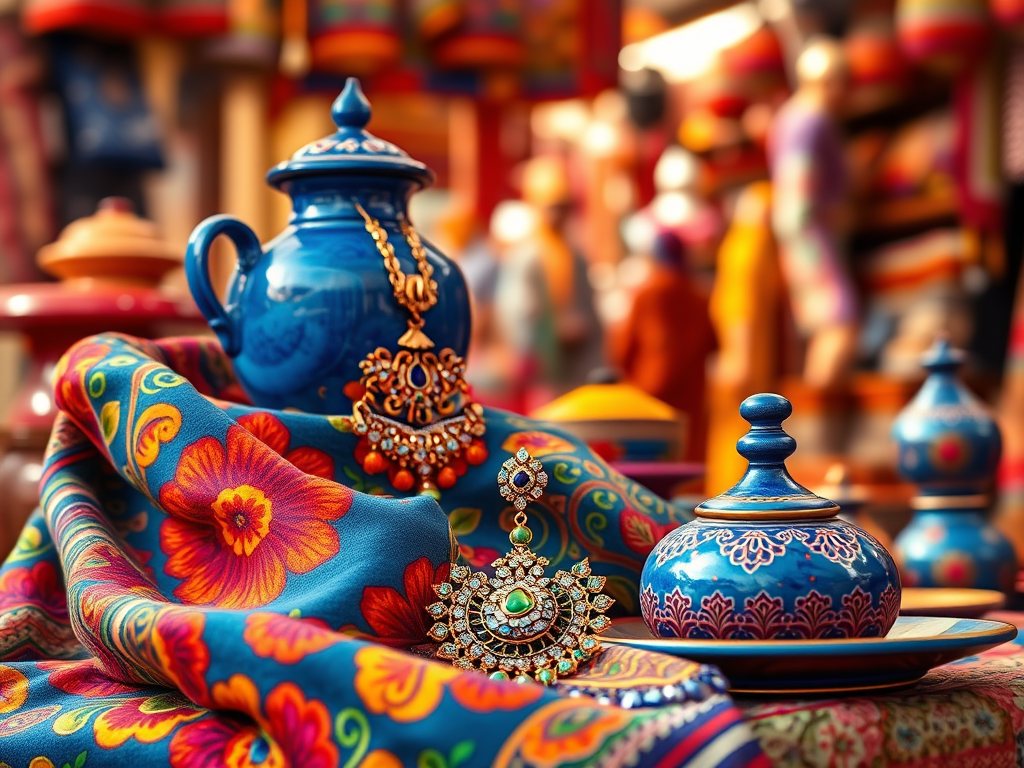
Explore the colorful legacy of Rajasthani handicrafts—from block-printed textiles and blue pottery to Meenakari jewelry. Discover history, iconic crafts, modern trends, and top markets in this ultimate guide to Rajasthan’s artistic treasures.
Table of Contents
Introduction: A Canvas of Colors in the Desert Kingdom
Rajasthan, the land of kings and endless sands, pulses with a creativity as vast as its Thar Desert and as intricate as the palaces of Jaipur. Here, handicrafts aren’t mere objects—they’re living stories etched in vibrant threads, shimmering enamels, and terracotta blues. Imagine running your fingers over a block-printed sari, its motifs blooming like desert wildflowers, or holding a piece of blue pottery that whispers tales of Persian influences under the Rajput sun. This is the vibrant world of Rajasthani handicrafts, a symphony of art forms born from royal patronage, nomadic ingenuity, and unyielding tradition.
From the bustling bazaars of Jaipur to the serene artisan villages of Jodhpur, these crafts embody the state’s soul: resilient, opulent, and fiercely colorful. Textiles flutter with tie-dye dreams, jewelry gleams like forgotten treasures, and pottery sings in sapphire hues. In a global market craving authenticity, Rajasthani handicrafts stand tall—sustaining over 2 million artisans and exporting millions annually, blending heritage with contemporary appeal. Whether you’re a collector, traveler, or home decorator, this journey invites you to immerse in their allure. Let’s wander through the looms, kilns, and forges where history meets handiwork, uncovering why these creations continue to captivate the world.
The Timeless Legacy: History and Significance of Rajasthani Handicrafts
The roots of Rajasthani handicrafts stretch back millennia, intertwined with the rise of Rajput kingdoms and the Indus Valley’s ancient echoes. Evidence from third-century punch-marked coins hints at early metalwork and textile trade, but the golden era dawned in the 16th century under Mughal-Rajput alliances. Raja Man Singh of Amber, inspired by Persian enameling during his time in Lahore, introduced Meenakari to Jaipur, transforming jewelry into jeweled poetry. Royal courts became patrons par excellence, commissioning opulent pieces for palaces like Udaipur’s City Palace, where miniature paintings chronicled epics and hunts.
These crafts weren’t just decorative; they were symbols of identity and survival. Nomadic tribes like the Banjaras wove block prints for trade routes, while potters in Jaipur adapted Persian techniques to create blue pottery, using quartz instead of clay for its luminous finish. The significance runs deep: Handicrafts preserved cultural narratives during invasions, fostered community economies, and aligned with Ayurvedic principles—natural dyes for health, intricate patterns for spiritual harmony.
In Rajasthan’s arid landscape, crafts like leather embossing from Jodhpur drew from camel-hide necessities, evolving into ornate bags and lamps. Today, they symbolize empowerment, with GI tags (Geographical Indications) protecting 20+ crafts like Kota Doria weaves and Molela clay plaques. As UNESCO recognizes Rajasthan’s intangible heritage, these artifacts bridge past and present, reminding us that true vibrancy lies in the hands that shape them.
Threads of Tradition: Textiles and Block Printing Marvels
No exploration of Rajasthani handicrafts is complete without its textiles—vibrant tapestries that drape the body and home like desert sunsets. Block printing, or Bagru and Sanganeri styles, reigns supreme. Artisans carve motifs—floral jaals, paisleys, and elephants—into wooden blocks, dipping them in natural dyes from madder root (red) or indigo (blue), then stamping onto cotton or silk with rhythmic precision. Originating in the 12th century, these prints adorned royal tents and trader caravans, their geometric patterns echoing temple architecture.
Bandhani tie-dye, from Bhilwara, twists fabric into tiny knots before dyeing, creating “points” that burst in crimson and saffron—perfect for lehengas and turbans. Leheriya, with diagonal waves mimicking monsoon ripples, and Kota Doria’s feather-light silk-cotton weaves from Kota complete the quartet. These aren’t static; they’re sustainable, using low-water alizarin processes revived by modern cooperatives.
In homes, they manifest as bedspreads, cushions, and quilts (godhadi), stitched by women in patchwork symphonies of recycled saris. Their significance? Textiles empowered rural women, turning looms into lifelines—today, over 500,000 weavers sustain families, blending age-old techniques with eco-fabrics for global runways.
Sapphire Dreams: The Art of Blue Pottery and Terracotta
Jaipur’s blue pottery is a cerulean love letter to Persian roots, introduced in the 19th century by Sawai Ram Singh II. Unlike clay, it’s fashioned from quartz stone powder mixed with glass frit and fuller’s earth, hand-molded into vases, tiles, and lamps, then glazed with copper oxide for that iconic turquoise sheen. Intricate floral arabesques and geometric jaalis adorn these pieces, fired at low temperatures to preserve vibrancy—each a testament to patience, as motifs are etched freehand.
Terracotta, Rajasthan’s earthy counterpoint, thrives in Molela village near Udaipur. Artisans press local clay into votive plaques (ayds) depicting deities like Devnarayan, sun-baked and painted in mineral hues for temple rituals. From Pokaran’s black pottery to Bikaner’s glazed tiles, these crafts echo ancient Indus kilns, symbolizing fertility and protection.
Their allure lies in functionality fused with finesse—blue platters for Diwali feasts, terracotta horses guarding hearths. In 2025, sustainable glazes and upcycled quartz keep them relevant, adorning boutique hotels from Jaisalmer to international expos.
Strokes of Splendor: Miniature Paintings and Wooden Whimsies
Rajasthani miniature paintings are pocket-sized epics, capturing Mughal courts and Krishna’s leelas on ivory, silk, or paper with squirrel-hair brushes and gemstone pigments. Schools like Mewar (Udaipur’s romantic vignettes) and Kishangarh (Bani Thani’s ethereal beauties) flourished under 16th-century patrons, their gold-leaf borders shimmering like palace frescoes.
Wood carving, from Jodhpur’s sheesham panels to Alibaug’s sandalwood elephants, adorns haveli doors and swings (jhoolas). Intricate jaali screens filter light like lace, while painted cradles (palna) cradle folklore.
These arts preserve narratives—paintings as historical diaries, carvings as architectural poetry. Modern twists include framed sets for urban walls, sustaining workshops amid tourism booms.
Gems of Grace: Jewelry and Metal Mastery
Rajasthani jewelry dazzles with Kundan and Meenakari—uncut gems set in gold foil (Kundan) for polki necklaces, or enamel-backed stones (Meenakari) in vivid reds and greens. The Kachchhi Bhatias of Jaisalmer craft silver oxidized pieces, while tribal Boras add mirrorwork to amulets.
Metalwork shines in Bidriware from Jodhpur—silver inlay on blackened zinc for boxes—and brass utensils from Beawer, etched with floral repoussé. Lacquerware from Jaipur, vibrant bangles and toys, adds playful pops.
These adornments symbolize status and spirituality—mirrors warding evil, gems invoking prosperity. In bridal troves, they endure, with hypoallergenic silvers trending for everyday elegance.
Leather and Lac: Everyday Elegance from the Sands
Leather crafts from Sanganer and Jodhpur turn camel hides into embossed journals, mojari shoes, and dhol drums, dyed in vegetable tannins for durability. Lac bangles from Jaipur, molded from resin and sequins, chime with festive joy.
These utilitarian arts reflect nomadic life—bags for caravans, instruments for folk tales. Eco-leathers from cork now blend in, appealing to conscious buyers.
Marble and Stone: Sculpted Sentinels of the Desert
Makrana’s marble, veined like milk rivers, births inlaid tabletops and jali screens from Agra’s Taj legacy, adapted in Jaipur. Stone carving in Bundi crafts elephant statues, their trunks curling in eternal grace.
These enduring forms grace forts and gardens, symbolizing permanence amid shifting dunes. CNC hybrids preserve precision for 2025 exports.
Modern Renaissance: Trends and Sustainability in 2025
Rajasthan’s crafts evolve with global pulses—block prints on fusion kaftans, blue pottery in minimalist lamps. 2025 sees AI-assisted designs and blockchain for artisan traceability, boosting e-commerce via platforms like Etsy. Sustainability surges: Natural dyes, solar kilns, and women-led co-ops like SEWA empower 100,000+ makers.
Trends favor upcycled jewelry and eco-textiles, with Jaipur’s PDKF Store fusing homeware and fashion. Challenges like mechanization persist, but GI protections and tourism (pre-Diwali spikes) ensure vitality.
Bazaar Trails: Where to Unearth Rajasthani Treasures
Jaipur’s Johari Bazaar gleams with Kundan gems and block prints, while Bapu Bazaar offers affordable juttis and bandhani. Jodhpur’s Sardar Market hums with wooden carvings; Udaipur’s Hathi Pol Bazaar showcases miniatures and lacquer.
For bulk or modern buys, Delhi’s Dilli Haat mixes Rajasthan stalls with fusion. Online: iTokri and Rajasthan Studio Cabinet curate authenticated pieces. Pro tip: Haggle ethically, visit cooperatives like Dastkar for fair trade. Diwali 2025 markets in Jaipur promise brass and pottery bonanzas.
Conclusion: Weaving Eternity in Threads and Clay
The vibrant world of Rajasthani handicrafts is a desert mirage turned tangible—colors that defy aridity, forms that echo eternity. From royal enamels to street-side leathers, each piece carries the warmth of artisan hands, inviting us to collect not just objects, but stories.
As 2025 unfolds with sustainable innovations, these crafts remind us: Beauty blooms in tradition’s soil. Next trip to the Pink City? Lose yourself in a bazaar. Until then, let a blue vase or printed dupatta bring Rajasthan home. What’s your favorite Rajasthani craft? Share below—let’s celebrate the makers who color our world.



Leave a Reply